

The bilingual site devoted to the cultural life in Sri Lanka and in France                                                        
hex2.jpg
Le site bilingue consacré à la vie culturelle au Sri Lanka et en France

| Home | Culture | Death Penalty | Events | Focus | Gallery | Heritage |
| Meditation | Photography | Poetry | Paul Cézanne | Saint-Exupéry | Theme | Voyageurs | Contact Us |


"Every condemned one will have a severed head..."

        
An Execution by an Elephant, in An Historical Relation Of the Island Ceylon, Robert Knox, London, 1681.

"Neither sun, nor death can be looked at fixedly"

François de La Rochefoucault (1613-1680).

If I can give evidence that this sentence is useless and unnecessary, it would be a great achievement for the sake of the humanity."

Cesare Beccaria (1738-1795),
Dei delitti e delle pene
(On offences and punishments),1764.

"Crime is redeemed by remorse, but not by a blow of the axe or slipknot. Blood has to be washed by tears but not by blood."

Victor Hugo (1802-1885), Aux habitants de Guernesey, 1854.


"...The death penalty is abolished."


Page content


20 years ago, the death penalty was abolished in France.

At this occasion, many events are organised in Paris :


USA
24 août 2001

He has been declared innocent after 18 years in the death row.

A condemned American who was for 18 years in the death row has been declared guiltless, following the communication of DNA tests and released from a prison in Idaho.

In 1982, Charles Fain has been condemned to death for the rape and the murder of a nine years old girl. At this time, the FBI assessed that the hair found on the victim was belonging to him. The tests give the evidence of the contrary.

According to the Information center on death penalty, Charles Fain is the 97th condemned to death being declared innocent and released from the death rows in 23 different States since 1973.
The death penalty was reestablished in 1976 in United States.
From 1976, 727 condemned have been executed - 44 in 2000.


"The First World Congress against Death Penalty"
June 21st, 22nd and 23rd, 2001, Strasbourg (France)

At the dawn of this New Millenium, death penalty is applied by almost 50% of the Sates in the world !

Five States record 85% of the executions: China, United States, Democratic Republic of Congo and Saudi Arabia.

The Association « Ensemble contre la peine de mort » (Together against the death penalty) mobilizes around the world in order to promote the universal abolition of the death penalty. This association circulates a petition asking for a moratorium.

The workshop proceedings appear on the following web site : www.ecart-type.com


GENEVE
30 March 2001

Jacques Chirac calls for the universal abolition of death penalty
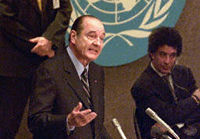
    Jacques Chirac, the first French president to speak at the Commission of Human Rights in Geneva, presented himself as a defender of humanism and liberty, by calling solemnly for "the universal abolition of the death penalty."

    The first step should be "a general moratorium", he said. "More than hundred countries have abolished the death penalty, and every year 3 or 4 new States join the camp of abolitionists as the conviction is deeply implanted that, in no way, death could not constitute an act of justice". He also highlighted that "no justice is infallible" and "each execution can kill an innocent".

In 1981, Jacques Chirac was in the minority of conservative parliamentarians who voted in favour of the abolition of the death penalty proposed by socialist Robert Badinter.

The French president addresses the same condemnation to USA and also to all countries which implement the death penalty, such as India, China and Muslim countries.

United States of America

Number of prisoners who are under the shade of the death is 3700.
In 1999, 100 were executed.
In Texas (20 million inhabitants), where G. W. Bush is the Governor, 149 prisoners have been executed in 5 years. This is a bigger number than the number of executions in France (58 million inhabitants) from the end of the Second World War.

USA are the last great democratic country which has not abolished the death penalty :
680 executions since 1977.


The State of Texas breaks the dreadful
record in the number of executions (40)
during one year in an American State. (AFP)

    The debate is reactivated with the arrival of Georges W. Bush at the White House.

    The man who is nicknamed by abolitionists all around the world as the "Texecutioner" (149 demands of execution during his five years mandate of Governor) has received an open letter from the General Secretary of Amnesty International. He is invited to place human rights at the "forefront of his programme".

    Le Monde2, February 2001.


The International Context

According to Amnesty International :

at least 2,258 prisoners in 37 countries were known to have been executed in 1998. In 1998, 86% cent of all known executions took place in China, the Democratic Republic of Congo, the USA and Iran.

4,845 persons in 78 countries were known to have received death sentences.

Internationally, capital punishment is widely considered as a human rights issue.

Three major international protocols & covenants calling for worldwide abolition of the death penalty are sponsored by the United Nations, the Organization of American States, and the Council of Europe.


Sri Lanka

Daily News, Friday 24th November 2000.

Death penalty to be executed

The Central Executive Committee of the People's Alliance decided on Wednesday to have the "death penalty" executed to curb the growing trend of crime. The Committee also agreed to amend laws regarding the bailing out of criminals and prevention of prolonging delay court cases.


The Island, Friday 24th November 2000,
By Shamindra Ferdinando

Govt. decides to implement death penalty

The government on Wednesday (22) decided to implement the death penalty as part of a series of proposed tough measures to combat rising wave of crime and violent incidents, senior party officials said yesterday.
The decision was taken at an Executive Committee meeting of the People's Alliance held on Wednesday night.

Saturday 18, November 2000, Daily News
by Kumar Wethasinghe

Death penalty for Hokandara killers

Three of the four accused in the Hokandara mass killings were sentenced to death after being convicted by the Trial-at-Bar at Hulftsdorp, yesterday. They were found guilty of the cold blooded murders of a family of six at Amaragoda Road, Hokandara in February, last year.

Saturday 18, November 2000, The Island
By Chitra Weerarathne

Death sentence for Hokandara murderers


(Pic. by Eranga Jayawardena)

The High Court Trial-at-Bar held in Colombo yesterday imposed a death sentence and a rigorous imprisonment term of 40 years, on the first three accused persons found guilty of the murder of five members of one family at Hokandara last year.

These three accused persons were convicted of murder and also convicted of gang rape and robbery.

The rigorous imprisonment for the latter two offences running consequitively, amounted to a total of 40 years.

The fourth accused was convicted of gang rape only with a 20 year RI term. The three member Trial-at-Bar comprised three High Court Judges.

Six members of one family were murdered on October 10, 1999 at Hokandara at the home of the deceased.

The details of the judgement explained that the first three convicts are the first three accused persons, namely H. E. Menaka Sanjeewa alias Ukkuwa (aged 19 years), K. J. Sampathsri Nandana (25 yrs), S. A. Mahinda Siriwardene (21 yrs.).

Death sentences were imposed on them for the killing of 5 persons.

The first three accused and the fourth accused H. P. Gayan Suranga (aged 17 years), were all convicted for the gang rape of Chitra Dayangani on the day of the killing. They were each imposed 20 years rigorous imprisonment.

Daily News, Friday 01st December 2000.

Two sentenced to death

Death sentence was passed by High Court Judge Balapitiya Mahanama Tilakaratne on the wife and her paramour who killed her husband conjointly with her lover at Pathegama, Balapitiya on 31.5.1991.

The two accused were Madihe Nandasena de Zoysa and Kusamalatha Zoysa of Pathegama, Balapitiya. The charges were framed against these two accused by the Ahungalla police for cutting and murdering Handunetti Wimalasena de Zoysa of Pathegama.

The deceased's body was found inside a well with severe cut marks.

The second accused Kusumalatha daughter gave evidence against her mother and their servant girl also gave evidence against the second accused.

PC Ameen appeared on behalf of first accused and Mahatunge attorney-at-law appeared for second accused. State Counsel Madhava Tennekoon prosecuted.

Sunday Leader, Sunday 3rd December 2000.

Wanted : a hangman

Despite the government deciding to revive the death sentence, the gallows are in need of a hangman. "Yes, we are in need of a hangman," Justice Minister Batty Weerakoon told The Sunday Leader.

The minister however observed that there would not be much difficulty in finding a replacement. "I don't see any difficulty. Our society is so brutalised, there will be so many assiparants," he said.

The gallows have not been put to operation since 1976. The former hangman, a father and a son, are long since deceased. The prisons department has kept the gallows at Welikada and Bogambara in proper working order with constant servicing.

There are 57 condemned prisoners at Welikada. Family members of some of the prisoners told The Sunday Leader that the prisoners have been given a new uniform and separated.Their heads have been shaven and told that they have to wait till President Chandrika Kumaratunga returns from abroad to know their fate.

Minister Weerakoon reiterated that not all 57 cases on death row will be executed. "Only those who do not qualify in the final overview of the sentences passed will be executed," he said. The justice minister asserted that each case will be studied and independent observations made by both himself and the Attorney General K. C. Kamalasabayson. These observations will be submitted to President Kumaratunga for a final verdict.

Meanwhile, Ricardo Bradley Keegal, sentenced to death 15 years ago for the murder of Tony Martin has already been prepared for execution. Members of the Keegal family told The Sunday Leader Ricardo has had his hair cut very short and dressed in a white sarong and white shirt. Keegal has been told to ready himself for execution. He has been sentenced to death together with a Chinese national Sheik' who was also found guilty. All three were former rugby players for Havelocks.


Asma Jahangir

United Nations Special Rapporteur on Extrajudicial, Summary or Arbitrary Executions,
Ms Jahangir was in Sri Lanka to deliver this years
Neelan Tiruchelvam Commemoration Lecture.
It was delivered by her at the BMICH on January 30 under the title,

"Death Penalty as Extrajudicial Killing".

Ms. Jahangir's visit was organised by
the International Centre for Ethnic Studies, Colombo.

  • Western European countries enjoying the least crime rates in the world have not provided for capital punishment or the death penalty.
    So far there have been no studies to link the crime rate of a country to the death penalty.

  • The death penalty is a violation of the right to life - a most fundamental of human rights.

  • The possibility of making mistakes in the execution of this punishment exists.

  • The irreversibility of death is one cogent reason why capital punishment should be approached with the utmost caution.

  • There is a pronounced tendency for capital punishment to discriminate against those who are already disadvantaged.
    It could be noticed that those in Death Row usually come from disadvantaged groups such as religious and racial minorities.

  • Jahangir explained that the certainty of punishment alone brings down crime.
    If we are seeking to strengthen fundamental rights and the Rule of Law, we must end the impunity to punishment enjoyed by some social classes. For instance, the armed forces and the influential sections of society.

    Excerpts from the article
    "Containing crime and violence in South Asia"
    by Lynn Ockersz
    Thursday 08, February 2001, Daily News, Colombo.

    Robert Badinter

    The vocation of abolition is to be universal.

        By Robert Badinter

        Senator and editorialist of Nouvel Observateur.
        Author of "L'Abolition", Fayard, 2000.

        The Prize of the Political Book 2001 (Prix du Livre politique 2001) has been awarded to Robert Badinter for "L'Abolition".

    The poisons that are carried by death penalty are at work by distressing the justice in USA like everywhere and always.

    Social Inequality

    That are the most defavoured groups in society, the children of Black or Hispanic ghettos, who make almost the totality of the condemned men. Most of this accused are unable to afford the expenses needed for their defense in front of the considerable means of the accusation. They are only assisted by the court-appointed lawyers who are not well paid and often unexperimented.

    The statistics speak clearly : according to a recent survey of the University of Colombia,

    on 5700 death condemnations which have been pronounced from 1977 to 1995,

    4578 have been cancelled as a result of different mistakes in proceedings : violations of the law, serious breach of duties among the advocates and the worst is the concealment of proves or witnesses for defense. These terrible grieves led to many judicial errors :

    87 condemned to death have been released after having been recognized innocent.

    Racism

    When Afro-Americans represent 12% of the population in USA, they compose 34% of the executions. In Texas, 34% of the condemned to death have been accused for murdering white women.

    Conversely, 0.4% of the condemnations to death have been pronounced for murdering a Black.

    Inhumanity

    The USA hold the record of the executions of the condemned, who were under 18 at the time of their crimes, disregarding the international conventions that ban these executions.

    And what to say about the executions of the retarded persons, more particularly in Texas!

    (Excerpts)


    Death Penalty and Religion

    Christianism

    "The condemnation to death of a human person means the negation of his improvement capacity. By using this punishment, a Christian expresses doubts about the power of the grace, the universality of Redemption, and the possibility of the conversion.
    Even at the term of a regular judgement, the society cannot have man's life in one's hands under the pretence of his culpability.

    The right to live is absolute and death penalty is one of the manifestations of the contempt for human life."

    Social Commission of the French Episcopate, January 23th 1978.


    Letter to The Island (Sri Lanka), Monday 4th December 2000.

    Death penalty : A bad noose

    by Rev. Dalston Forbes OMI
    Colombo 15

    There is a proposal before parliament to restore the death penalty owing to the upsurge in grave crimes like armed robbery, murder and multiple murders, rape with murder, political assassinations etc. For several years now, the death sentence, though passed by the Judges in terms of the Law, is not implemented and is reduced to life imprisonment.

    Many organisations like Amnesty International have spoken against carrying out the death sentence. Pope John Paul II has come out against it on several occasions. Thus to quote the Encyclical on Human Life, 'Evangelisum Vitae' No. 56; "This is the context in which to place the death penalty. On this matter there is a growing tendency, both in the Church and Civil Society, to demand that it be applied in a very limited way or even that it be abolished completely. The problem must be viewed in the context of a system of penal justice ever more in line with human dignity...."

    He goes on to refer the expiatory and deterrent quality of punishment and then adds:

    "It is clear that, for these purposes to be achieved, the nature and extent of the punishment must be carefully evaluated and decided upon and ought not to go to the extreme of executing the offender except in cases of absolute necessity; in other words when it would not be possible otherwise to defend society. Today however, as a result of steady improvements in the organisation of the penal system, such cases are very rare, if not practically non-existent".

    The Catechism of the Catholic Church says the same thing in No. 2267.

    This being the case, it would be most unwise and retrogressive to implement the death sentence once again. Let other means be found to rid society of grave crimes.

    Donavan Moldrich, late editor of the 'Times of Ceylon' and well known journalist wrote well on this subject in his book:

    "Hangman, spare that noose", Committee for Abolition of Death Penalty", Colombo, 1983.

    I commend this book to your readers.

    Tibetan Buddhism

    August 29, 1999

    Message Supporting a Global Moratorium on the Death Penalty


    Bodhisattva Siddhartha,
    gold coloured bronze, end of 18th century, Musée Guimet.

      by the Dalai Lama

      In general, death is something none of us wants, in fact it is something we don't even like to think about. When death takes place naturally, it is a process beyond our control to stop, but where death is willfully and deliberately brought about, it is very unfortunate.

      Of course, within our legal systems there are said to be certain reasons and purposes for employing the death penalty. It is used to punish offenders, to prevent them ever repeating their misdeed and to deter others. However, if we examine the situation more carefully, we will find that these are not the real solutions.

      Harmful actions and their tragic consequences all have their origin in disturbing emotions and negative thoughts, and these are a state of mind, whose potential we find within all human beings. From this point of view, every one of us has the potential to commit crimes, because we are all subject to negative disturbing emotions and negative mental qualities. And we will not overcome these by executing other people.

    What is deemed criminal can vary greatly from country to country. In some countries, for example, speaking out for human rights is considered criminal, whereas in other countries preventing free speech is a crime. The punishments for crimes are also very different, but usually include various forms of imprisonment or hardship, financial penalties and, in a number of countries, physical pain. In some countries, crimes that the government considers very serious are punished by executing the person who committed the crime.

    The death penalty fulfills a preventive function, but it is also very clearly a form of revenge. It is an especially severe form of punishment because it is so final. The human life is ended and the executed person is deprived of the opportunity to change, to restore the harm done or compensate for it.

    Before advocating execution we should consider whether criminals are intrinsically negative and harmful people or whether they will remain perpetually in the same state of mind in which they committed their crime or not. The answer, I believe, is definitely not.

    However horrible the act they have committed, I believe that everyone has the potential to improve and correct themselves. Therefore, I am optimistic that it remains possible to deter criminal activity, and prevent such harmful consequences of such acts in society, without having to resort to the death penalty.

    My overriding belief is that it is always possible for criminals to improve and that by its very finality the death penalty contradicts this.

    Therefore, I support those organizations and individuals who are trying to bring an end to the use of the death penalty.

    Today, in many societies very little importance is placed on education or the development of human values through social programs and entertainment. In fact, if we take television programming as an example, violence, including killing, is regarded as having a high entertainment value. This is indicative of how misguided we have become.

    I believe human beings are not violent by nature. Unlike lions and tigers, we are not naturally equipped to kill with sharp teeth and claws.

    From a Buddhist viewpoint, I believe that the basic nature of every sentient being is pure, that the deeper nature of mind is something pure. Human beings become violent because of negative thoughts which arise as a result of their environment and circumstances.

    I wholeheartedly support an appeal to those countries who at present employ the death penalty to observe an unconditional moratorium. At the same time we should give more support to education and encourage a greater sense of universal responsibility. We need to explain the importance of the practice of love and compassion for our own survival and to try to minimize those conditions which foster murderous tendencies, such as the proliferation of weapons in our societies. These are things even private individuals can work towards.

    Emphasis by the editor.


    The long way towards the ABOLITION

      Beccaria    Howard    Le Peletier de Saint-Fargeau

          Lamartine    Hugo     Jaures    Briand    Mitterrand     Badinter

    Revenge eliminates, justice reintegrates...

    Many countries have abolished the death penalty, others do not apply it. Nevertheless, in case of some threats for the society (violence, criminality, drugs...), there are voices calling for its reintroduction.
    This discussion goes back to the 18th Century.

    18th Century


    Cesare Beccaria (Italy)

    In 1764, he published : Dei delitti e delle pene .Toscane is the first State to abolish the death penalty (1786).

    John Howard (England)

    In 1775, he published : State of the Prisons .

    19th and 20th Century

    The death penalty progressively disappears from the whole battery of repressive methods. Nevertheless, the way toward the legal abolition remains a long and chaotic way. Sometimes, as a reaction to politic or criminal events, there is a reintroduction of the death penalty.

    These are the dates of legal abolition in different countries: Portugal, 1867; Holland, 1870; Norway, 1905; Sweden, 1921; Denmark, 1930; Switzerland, 1942; Italy, 1944; Finland and Germany, 1949; Austria, 1950; United Kingdom, 1965; Spain, 1978; France, 1981.

    Most of the South America States and a part of United States have also abolished the death penalty. In Europe, Greece and Turkey are not abolitionist.

    This evolution originates from emotional reactions against a blinkered justice This does not make it any the less necessary to think about the three fundamental questions which concern the death penalty issue :

    The question of principle or the right of the State upon life;

    The question of capital punishment or the concept of its deterrent nature;

    The question of alternative punishments and the reintegration of prisoners.

    THE THREE FUNDAMENTAL ISSUES

    The right of the State towards life

    Has the society, in the person of the State, the right to suppress life as an ultimate sanction of an unpardonable crime?

    Everybody agrees that the state power possesses a constraint power, which is not allowed to individuals. Is this power excludes death?

    If we say yes, we postulate that there is a future for the convicted prisoner. It means that, on one side the society is ready for undertaking a process of reintegration, on the other side that the prisoner is ready for a process of reeducation, a process of change. Do the errors of the past allow think about the future? Are we disposed to live later with this criminal? It is the great challenge which is proposed to the society by all militants who, yesterday and now, have pursued their fight against the capital punishment.

    The partisans of the death penalty argue that the situation is irremediable, and no reintegration possible.

    The deterrent nature of the death penalty

    There is no way to reply to horror by using horror. (Abbé Clavier, prison chaplain)

    No convincing statistics can give the evidence that abolitionist countries know an increase in their rate of criminality.
    The use of death penalty reveals a state of panic and consequently, an admission of weakness which belittles the society to the levels of its subjects to judgement.

    By making an example, we always renounce to the justice and lapse into the terrorism. The judge echoes the social fear...
    The judicial assistance and the punishment conditions will be quite different depending on whether you are powerful or miserable...

    In vain, with a lot of international investigations, I took great care to establish that, in all abolitionist countries, the murders have not increased. The rate of serious crime is always the same, whatever the presence or the absence of the capital punishment in the criminal legislation. (...)

    The deterrent value is a myth. There is no serious study which is able to corroborate it.

    There is no example of a potential criminal who abandons the idea of committing a crime by fear of the guillotine.

    Whether the criminal believes that he will get away from the police and he will commit the crime, or he will be afraid to be arrested and he will renounce. So, life sentence or guillotine, the kind of punishment doesn't much matter. In case of "cold blood" criminals, the determinant point is the conviction that he will not be arrested, and not, in case of arrest, the nature of the punishment. And concerning the most dreadful crimes, most of the time they remain inexplicable. (Pr Roumajon, psychiatrist)

    The ritual of the execution always included the expiatory sacrifice ; death for death in order to calm the anger of gods that is only the projection of our insurmountable anguish..

    Prisons and social reintegration

    The prisons' world should be the world of rehabilitation which starts, not the world of never-ending penalty : conservation of links between inside prisons and outside, coming out of the prison in a situation with open doors into professional, financial and affective dimensions.

    Modern societies reject the "definitive" solutions, and so acknowledge their responsibility and deficiencies, and intend to promote a repressive and curative approach at the same time.
    It means to have the courage to look at the practical consequences of this choice : refusal of prisons being places of exclusion and concrete definition of rehabilitation and reintegration programs.

    A society which bans the capital punishment as to be fully committed to become a society which allows the resumption of life.
    By giving to the prisoner all his chances of rehabilitation, our society manifests its respect of life, any life.

    I have given my preference, not to the passion of militants, but to the weight of experience. The purpose was to give evidence that the death penalty is useless.

    The purpose was to demonstrate that the death penalty is absurd, irrational, primitive.

    It was essential to convince that the death penalty is inhuman.

    This document on death penalty is based on the excellent article of the Encyclopaedia Universalis by André Dumas Pasteur, President of the magazine "Réforme" and quotations from "L'abolition" by Robert Badinter.


    Confluence

    Victor Hugo (1802-1885)

      "I vote for the pure, simple and definitive abolition of death penalty..."
      "...it is, for me, a deep and old conviction"

          15th September 1848
          Assemblée Constituante, Paris.

      In fact, the first movement has been an instinctive reaction of horror, anxiety and disgust. Sensation led to conviction, and conviction to the involvement in favour of he Abolition.

    Listen to the relation of Adele, Victor Hugo's wife, in her biography titled :

    "Victor Hugo raconté par un témoin de sa vie"
    (Victor Hugo related by a witness of his life).

    The scene occurs in 1812 in Burgos, Spain. The young Victor, ten years old, is on the way to join his father who is a General of the Napoléon's army.

    "A big crowd passed in front of the house. Victor, with his mother and brother, followed the crowd. They arrived to a square and saw a wood stage that was surmounted by a pal. They asked : "What is this?" and the answer was : "a scaffold on which a man will be garrotted". They were scared by this idea and run as fast as their legs could carry them. They met a brotherhood of penitents wearing cowls with two holes in the place of their eyes. This glances without visage looked gloomily for the children. Among these "ghosts", there was a man bound on a donkey. His back was turned towards the head of the animal. This man was stupefied by terror. Some priests presented him a crucifix, and he kissed it without looking at.


      Children ran away being terrified."


    Francisco Goya (1746-1828)

    "Man's brutality to man was nevermore vividly indected than in the tamplit scene of "3 May 1808" where the French shoot hostages, painted six years later with no loss of actual horror."

    From Giotto to Cézanne, Michael Levey, Thames and Hudson, 1997.

    3rd May 1808 (Los fusilamientos en la montana del Principe Pio),
    Madrid, Prado (1814).

    References

    Robert BADINTER

    Albert CAMUS / Alfred KOESTLER

    Victor HUGO


    Jean IMBERT


    L'Abolition, Fayard, 2000.

    Réflexions sur la peine capitale, Calmann-Lévy, 1979.

    Le dernier jour d'un condamné, Bibliothèque Gallimard, 2000
    The last day of a condemned man and other prison writings, translated by Woollen Geoff, Oxford University Press.
    Ecrits sur la peine de mort, Babel, Actes Sud, 1992.

    La peine de mort, QSJ, PUF.

       A translation in Sinhala :


    Our reflections and comments will complete this file. Your opinions are welcome.
    Read more about death penalty.


    | Home | Culture | Death Penalty | Events | Focus | Gallery | Heritage | Meditation | Photography | Poetry | Paul Cézanne |
    | Saint-Exupéry | Theme | Voyageurs | Contact Us |